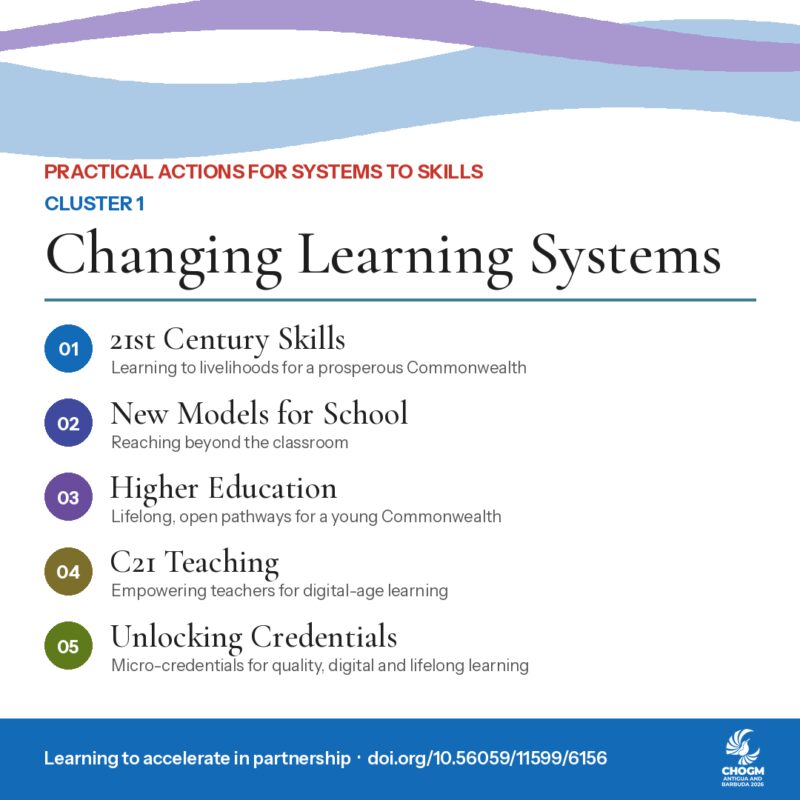
Changing learning systems to build a more skilled and resilient Commonwealth must be part of the conversation at #chogm2026.
As technology advances, the impacts of climate change intensify, and the skills needed for work evolve, education systems must adapt to prepare people for a changing world.
Under a broader call to change learning systems, COL advocates for more flexible, inclusive learning that builds future-ready skills, empowers teachers for the digital age, strengthens connections between education and employment, and expands lifelong learning opportunities.
Visit the handles on each card to explore the individual talking points, or discover our broader points for discussion: doi.org/10.56059/11599/6156
What will it take for #CHOGM2026 to deliver real change?
The Hon Shirley Botchwey, Commonwealth Secretary-General, sets out a clear vision for a different kind of meeting this year: one that puts partnerships, investment and tangible results at the heart of the Commonwealth’s agenda.
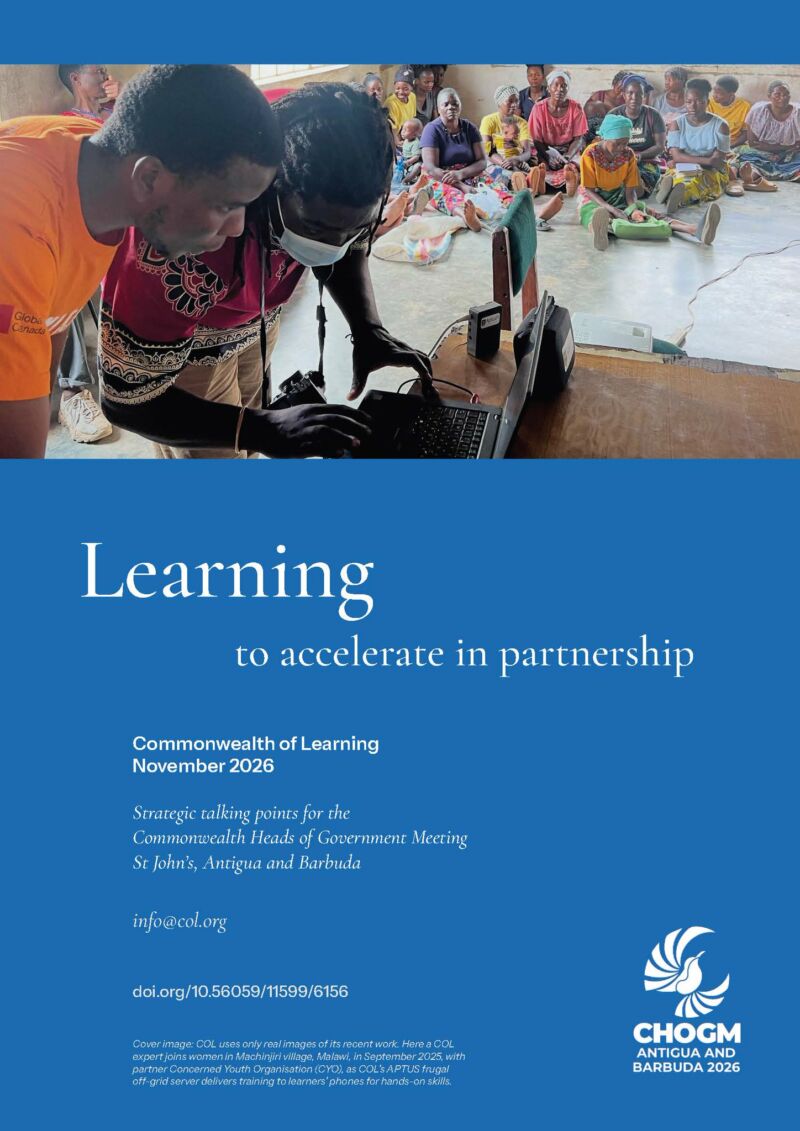
At COL, we echo this call for action. In our new publication, Learning to accelerate in partnership, we put forward 15 strategic talking points and 12 concrete opportunities for action for Commonwealth leaders to consider at and beyond CHOGM. From expanding flexible learning to equipping young people with the skills they need for a changing world, we're calling for stronger collaboration to respond to the evolving needs and aspirations of the Commonwealth’s 2.7 billion people.
With #chogm2026 just days away, leaders from across the Commonwealth are preparing to gather in Antigua and Barbuda to advance partnerships and investment for a more prosperous future.
That's why we've put together 15 strategic talking points and 12 concrete opportunities for action in our new publication, Learning to accelerate in partnership.
From transforming education systems and expanding flexible learning to developing digital, green, blue and creative economy skills, our key asks focus on equipping young people with the skills and opportunities to learn, lead, work and thrive.
Here's our challenge to CHOGM delegates and decision-makers: Explore the talking points, ask the difficult questions and come to the table ready to act. Where can collaboration make the greatest difference? What will it take to deliver results at scale? And how can we ensure no one is left behind?
Building a more resilient and prosperous future starts with investing in people. Explore our talking points and help turn shared ambitions into practical action: doi.org/10.56059/11599/6156
Changing learning systems must be part of the conversation at #CHOGM2026.
Under a broader call to change learning systems, COL advocates for flexible, inclusive learning that builds future-ready skills, empowers teachers for the digital age, strengthens connections between
COL is pleased to support the launch of the Africa Regional Centre for Open TVET (ARCOT). Hosted by @kstvet, the Centre will strengthen regional collaboration and promote the use of open and technology-enabled learning to expand opportunities for skills development, employment
With #CHOGM2026 just days away, we've put together 15 strategic talking points and 12 opportunities for action to help turn shared ambitions into practical action.
Our challenge to delegates: Explore the talking points, ask the difficult questions and come ready to act.
Research on women’s access to STEM education points to progress. But are those gains translating into equal opportunities to build careers and lead?
COL’s Women in STEM initiative (WiSE) is examining the gaps behind this question, bringing together researchers, policymakers and civil society to develop solutions that expand opportunities for women across STEM education, employment and leadership.
At a recent workshop in Kuala Lumpur, Malaysia, stakeholders from Brunei, India, Malaysia, Pakistan, The Gambia and Uganda discussed barriers, shared lessons on more inclusive policy and practice, and identified practical actions to help more women participate, progress and lead in STEM.
Rwanda’s higher education and teacher training institutions are taking important steps towards the responsible and effective use of artificial intelligence (AI). Through a collaboration between the Commonwealth of Learning (COL), the Higher Education Council (HEC) and the University of Rwanda (UR), representatives from nine higher education and teacher training institutions have come together in Kigali, Rwanda, for a three-day session to develop and strengthen institutional AI policies and guidelines.
The initiative aims to establish a coherent, future-ready framework that enables institutions to harness AI to improve the quality of education, foster innovation and promote ethical practices. The policies are being developed in alignment with national guidance from HEC as well as regional frameworks from the Inter-University Council for East Africa.
Opening the event, Dr Olivier Habimana, Head of the Department of Digitalisation and Research at HEC, highlighted the importance of clear AI policies and other institutional measures to support the effective integration of AI in education. In his welcoming remarks, Professor Florien Nsanganwimana, Principal of the College of Education at the University of Rwanda, emphasised the critical role of teachers in preparing learners for an AI-enabled future, noting the importance of AI literacy and ethics in supporting students.
This activity forms part of COL’s broader work in AI for Teacher Education work across Sub-Saharan Africa and the Caribbean. It reflects our commitment to promoting shared learning, locally relevant and collaborative solutions, open educational resources, and the responsible and sustainable integration of AI across education systems.
“Our task is not simply to put AI tools in teachers’ hands, but to strengthen their agency to decide when, why and how AI can improve teaching and learning,” says Dr Betty Ogange, Education Specialist: Teacher Education at the Commonwealth of Learning.
As AI becomes an increasingly integral part of education, responsible integration must begin with teacher education and professional development. This means embedding AI literacy, ethics, critical thinking and inclusive practices into teacher education policies, curricula and assessment.
Our latest story looks at how South Africa is translating AI literacy into practical action across teacher education. Read more at the news link in our bio. #ArtificialIntelligence #TeacherEducation #AILiteracy #Teachers #InclusiveEducation #SouthAfrica @highereduza @universityofpretoria @university_of_cape_town
5
0
This error message is only visible to WordPress admins
Error: There is no connected business account for the user .